Apollo Neuro Review 2026: Does It Really Work for Sleep & Stress?
-
August 19 , 2026
-
38
Quick Verdict
| Category | Verdict |
| Overall Rating | 8.6/10 |
| Best For | People interested in a non-drug relaxation and sleep-support wearable |
| Biggest Strength | Passive tactile stimulation that doesn't require staring at another screen |
| Main Drawback | High upfront price and ongoing premium-membership ecosystem |
| Sleep Potential | Promising, with stronger evidence than many wellness gadgets |
| Ease of Use | Very Good |
| Value | Good for committed users; questionable for casual experimentation |
Apollo Neuro Review: An Unusual Wearable With an Interesting Idea
Most wearables tell you what's wrong. Your watch tells you that you slept badly. Your ring reports low recovery. Your fitness tracker informs you that you're stressed. Then what?
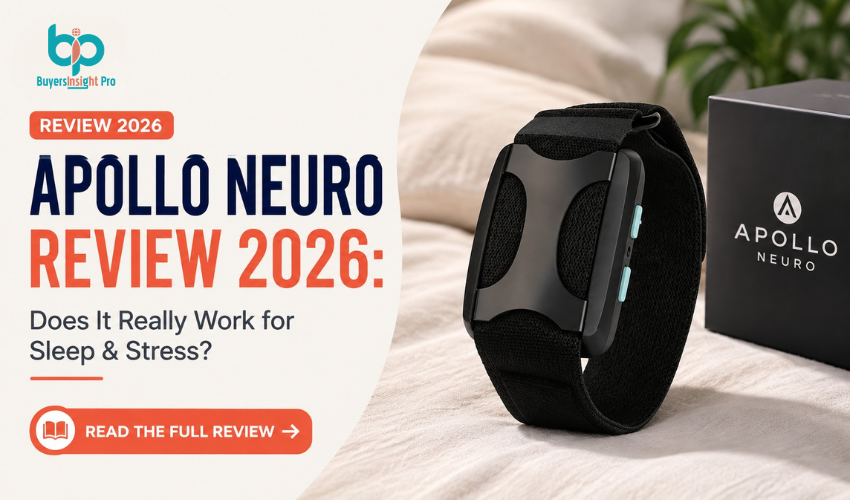
Apollo Neuro takes a fundamentally different approach. Instead of primarily measuring your body, the wearable is designed to do something while you're wearing it. The small device produces patterned vibrations or what Apollo calls "Vibes" that are intended to support different states such as relaxation, focus, recovery and sleep. You can wear it on your wrist or ankle, or attach it to clothing. It's an appealing proposition, particularly for someone who already knows they're stressed and doesn't need another dashboard reminding them.
But there's an obvious question: Does Apollo Neuro work, or are you paying hundreds of dollars for something that vibrates?
That's where this product becomes more interesting. Apollo now has a considerably larger research portfolio than many wellness wearables, including randomized placebo-controlled work involving HRV and cognitive performance, plus newer large-scale sleep research. At the same time, the strength and independence of the evidence varies substantially between studies. This Apollo Neuro review separates those promising findings from the marketing and examines what you're actually getting for the current $448 package price.
Check Today's Price
What Is Apollo Neuro?
Apollo Neuro is a wearable wellness device built around tactile stimulation. Rather than displaying notifications or continuously asking for your attention, it delivers gentle patterned vibrations against the body. Apollo's underlying theory is that specific patterns of soothing touch can influence how the nervous system responds to stress. The technology emerged from research involving psychiatrist and neuroscientist Dr. David Rabin and work associated with the University of Pittsburgh. The important distinction is that Apollo isn't simply a vibrating alarm. Its programs use different vibration patterns intended for different situations.
You might choose a more calming program before bed, another when concentrating on work, and a different one during recovery. The product therefore sits somewhere between a traditional wearable, a relaxation tool and a sleep accessory. It isn't a replacement for medical care, medication or treatment for a diagnosed sleep, psychiatric or neurological disorder. That distinction is particularly important because terms such as "vagus nerve," "nervous system regulation" and "stress relief" are frequently used very loosely across the wellness industry.
How Does Apollo Neuro Work?
Apollo delivers patterned physical vibrations through the skin. The premise is rooted in something fairly intuitive: touch can affect how we feel. Think about someone placing a reassuring hand on your shoulder. Compare that with being abruptly shaken. Both are physical sensations, but your brain interprets them very differently. Apollo attempts to make that principle repeatable using programmed vibration patterns. Earlier research conducted with University of Pittsburgh participants examined whether Apollo's vibration patterns could affect heart rate variability and cognitive performance during stressful tasks. Apollo reports that controlled trials found increases in HRV under certain active vibration conditions. HRV heart rate variability is essentially variation in the timing between heartbeats. It is influenced by the autonomic nervous system and is often used as one indicator of recovery and adaptability to stress.
Higher isn't universally "better" in every situation or across every person, but an improving individual HRV trend is frequently associated with better recovery. Apollo's current research page lists 17 completed studies and 12 ongoing trials involving more than 1,700 research participants. However, some listed studies are still unpublished or in preparation, and several have open-label rather than blinded designs. That nuance matters. There is legitimate research here, but not every number appearing in marketing material carries the same evidentiary weight.
Key Apollo Neuro Features
Wearable Tactile Stimulation
The defining feature is also the simplest. Apollo produces physical vibrations against your skin rather than relying on audio, a display or guided visual exercises. This is particularly appealing if you're trying to reduce screen time. You can start a Vibe and continue working, reading, traveling or preparing for sleep without keeping a meditation app open in front of you. Apollo says the device can be worn on the wrist or ankle or clipped to clothing. For everyday usability, that's important. A relaxation product only helps if you actually use it.
Different Vibes for Different Situations
The Apollo experience revolves around selecting vibration programs based on what you're doing. The objective isn't to make every program maximally relaxing. A bedtime program has a different purpose from something intended to support focus during work. This is where Apollo becomes more useful than a basic vibrating device. Rather than manually adjusting frequency or guessing what feels right, the software provides purpose-built sessions.
SmartVibes AI
Apollo has increasingly shifted toward personalization through its SmartVibes membership. The current Apollo Wearable package includes one year of SmartVibes AI membership, which the company values at $99. Apollo says membership provides more than 10 premium Vibes, new programs, personalization and sleep-related features intended to anticipate unwanted wake-ups. This improves the software experience but creates an important ownership consideration. You're not merely evaluating a piece of hardware. You're entering an ecosystem in which some of the more advanced functionality is membership-driven. Buyers who strongly dislike subscriptions should factor that into the total value before ordering.
First Impressions & Setup
Apollo looks more utilitarian than fashionable. That's not necessarily a criticism. It isn't trying to replace a luxury watch or disappear into a jewelry collection. The device needs reliable skin contact while remaining comfortable enough for prolonged use. Initial setup revolves around pairing the wearable with the companion app, selecting how you want to feel and choosing an appropriate Vibe. The physical sensation may surprise first-time users. Don't expect massage-gun intensity.
Apollo is supposed to provide comparatively subtle tactile cues. Turning the intensity up until the device becomes distracting defeats much of the purpose. This is one of those products where the first ten minutes aren't necessarily enough to judge it. The more meaningful question is whether using it consistently fits naturally into your routine and whether you notice changes over several weeks.
Apollo Neuro Sleep Review
Sleep is arguably Apollo Neuro's most interesting use case. It's also where the evidence has recently become considerably more compelling.
The 2026 Sleep Study
In July 2026, Apollo announced publication of a peer-reviewed study in JMIR mHealth and uHealth examining Apollo use alongside Oura Ring sleep data. The retrospective analysis covered 935 users and 474,852 nights of observation from 2019 through 2022. Apollo reported that device use was associated with approximately 46 additional minutes of sleep per night and a 77% reduction in the odds of sleeping less than six hours on a night when Apollo was used. Those numbers are impressive. But "associated with" is the crucial phrase.
This wasn't a large randomized trial assigning hundreds of participants to Apollo and placebo devices under controlled conditions. It analyzed real-world historical data from people already using Apollo and Oura. That means confounding variables cannot be dismissed. For example, people who consciously activate Apollo before bed may simultaneously engage in other sleep-supporting behaviors. The study is still useful particularly because nearly half a million nights is an unusually large dataset but it should not be interpreted as proof that buying Apollo automatically gives you 46 extra minutes of sleep.
Earlier Sleep Findings
Apollo's earlier observational work involved more than 500 Apollo users with Oura Rings. Preliminary results reported improvements in total sleep, REM sleep, deep sleep, resting heart rate and HRV among consistent users. Apollo noted that the biggest improvements appeared among people using the device at least three hours daily and five days per week. The study was sponsored by Apollo Neuroscience. Again, promising but worth interpreting conservatively.
What Does Apollo Feel Like at Bedtime?
This may actually be more important to many buyers than percentages. Apollo recommends using its Sleep Vibe at around 40% intensity for approximately 30–60 minutes once you're in bed. Unlike listening to a sleep story, you don't need headphones. Unlike scrolling through a meditation app, you aren't staring at a display. The wearable can quietly run while you settle down. For people whose main problem is difficulty transitioning from a mentally busy day into sleep, that passive quality is arguably Apollo's strongest practical feature.
Does Apollo Neuro Work for Stress?
This is more difficult to answer with one number. Stress isn't a single biological measurement. You can measure HRV, cortisol, heart rate and various psychological scales, but someone's subjective feeling of calm still matters. Apollo's research portfolio includes randomized and controlled studies examining HRV and cognitive performance under stress. One small double-blind placebo-controlled crossover trial involving 22 athletes reported statistically significant HRV improvements. Another controlled study involving 38 healthy adults examined cognitive performance and HRV, though Apollo's research page currently describes publication as still in preparation. Other studies listed by Apollo involve burnout, meditation, PTSD, migraine, concussion symptoms and additional populations. Some report statistically significant outcomes, but many are open-label, small, unpublished or still being prepared for publication.
So does Apollo Neuro work?
A reasonable answer is: There is credible evidence that Apollo's tactile stimulation can influence measurable physiological outcomes such as HRV, and the sleep evidence is increasingly interesting. But that does not mean every advertised wellness benefit is equally proven or that every user will subjectively feel a dramatic difference. That's a much stronger position than "it's just placebo," but also more defensible than treating every marketing claim as settled science.
Real-World Experience: Where Apollo Makes Sense
Apollo's biggest practical strength is effort or the lack of it. Meditation works for many people, but it requires active participation. Breathing exercises require attention. Exercise is highly beneficial for stress and sleep but requires time and physical effort. Apollo can operate while you're already doing something else. That makes adherence potentially easier. You could wear it while working at a desk, commuting, reading or winding down. The tradeoff is subtlety. Someone expecting a dramatic sensation followed by immediate transformation may be disappointed. Apollo isn't intended to sedate you or produce an obvious altered state. For some people, that subtle nature is exactly what makes it sustainable. For others, it makes a $448 purchase feel difficult to justify.
Pricing & Value: Is Apollo Neuro Worth It?
This is Apollo's biggest hurdle. As of August 2026, the official US store lists the Apollo Wearable + one-year SmartVibes AI membership for $448. The included one-year membership is valued by Apollo at $99. That's substantial. At this price, Apollo isn't competing with inexpensive sleep accessories. It's competing for budget with premium fitness wearables, smart rings, therapy devices and other high-end wellness technology. Whether it's worth the money depends heavily on your intended use. If you use Apollo for 15 minutes twice, feel nothing dramatic and put it in a drawer, it's terrible value.
If it becomes part of a daily routine focus sessions during work, relaxation in the evening and sleep support every night the cost-per-use becomes far easier to defend. The newer sleep research also strengthens the value argument compared with buying an untested wellness gadget. Still, we'd prefer to see Apollo's premium price accompanied by fewer long-term software restrictions. A physical wellness product approaching $450 should remain highly functional even when a customer chooses not to maintain a paid membership.
Explore BRAND Collections
Apollo Neuro Pros & Cons
| Pros | Cons |
| Growing body of clinical research | $448 current package price is expensive |
| Large 2026 peer-reviewed sleep study | Sleep study is observational, not randomized |
| Doesn't require constant screen interaction | Effects may feel subtle |
| Can be worn while doing other activities | Individual response will vary |
| Sleep, calm, focus and recovery Vibes | Premium ecosystem includes membership component |
| Wrist, ankle and clothing placement | Another device to charge and manage |
| Controlled research supports HRV effects | Several studies remain unpublished/in preparation |
| Non-drug approach | Not a substitute for medical treatment |
Who Should Buy Apollo Neuro?
Apollo makes the most sense for people who already understand that behavioral wellness tools generally require consistency. If you're willing to incorporate the device into a daily routine for several weeks rather than judge it after one session, you're much closer to Apollo's ideal customer. It's especially interesting for people who struggle to mentally transition into bedtime but don't want another screen-based sleep product. Existing Oura, Apple Watch or WHOOP users may also appreciate being able to observe whether their own sleep and recovery metrics change over time.
| Buyer | Recommendation |
| Sleep optimization enthusiast | Excellent fit |
| High-stress professional | Very Good |
| Existing Oura user | Very Good |
| Meditation beginner | Very Good |
| Biohacking enthusiast | Excellent fit |
| Subscription-averse buyer | Think carefully |
| Budget shopper | Poor fit |
| Seeking treatment for a medical condition | Talk with a healthcare professional |
Who Should Avoid Apollo Neuro?
Apollo isn't for everyone. First, avoid it if you're expecting a medical treatment for insomnia, anxiety, PTSD or another diagnosed condition. A wellness wearable should not replace appropriate medical evaluation or evidence-based treatment. Second, skip it if you're uncomfortable spending hundreds of dollars on something whose subjective effect may be subtle. There's meaningful research behind Apollo, but individual results remain individual. Third, Apollo is less attractive if you dislike app-connected hardware and subscription ecosystems. And finally, don't buy it if your basic sleep habits are severely neglected. A wearable cannot compensate for consistently sleeping four hours because you're scrolling until 3 a.m., drinking excessive caffeine late in the evening or maintaining an impossible schedule. The fundamentals still matter.
Apollo Neuro Reviews: What Does Customer Feedback Tend to Say?
Customer experiences with products like Apollo are naturally more varied than experiences with something simple such as headphones. One person may immediately notice the vibration helping them settle. Another may enjoy the sensation but see no meaningful difference in sleep. A third may only notice an effect after weeks of consistent use. This is precisely why customer anecdotes shouldn't substitute for controlled research. Apollo itself reports high rates of users feeling calmer, sleeping better and experiencing better focus, but these figures are company-reported and shouldn't be interpreted as independent clinical success rates.
The broader pattern worth paying attention to is that positive users often emphasize routine and subtle changes rather than a dramatic "switch." Critical buyers tend to focus on price, uncertainty about whether the sensations materially change outcomes, and the value proposition of the membership model. Those are reasonable concerns.
Apollo Neuro vs Sensate
Apollo and Sensate are often grouped together because both use vibration-based approaches to relaxation. But they're not identical. Sensate is positioned as an infrasonic resonance device worn against the chest and paired with audio experiences. A typical session is more deliberate you generally stop what you're doing and relax with the device. Apollo is designed to be worn more continuously while you're doing other activities. That makes Apollo more versatile throughout a normal day.
| Feature | Apollo Neuro | Sensate |
| Core approach | Tactile vibration patterns | Infrasonic chest vibration + audio |
| Placement | Wrist, ankle, clothing | Chest |
| Use while working | Easy | Less convenient |
| Sleep focus | Strong | Relaxation-oriented |
| Guided audio required | No | Typically integrated |
| Session style | Passive/continuous | More deliberate |
| Current price positioning | Premium | Premium |
| Best for | All-day integration | Dedicated relaxation sessions |
Pulsetto's current comparison page lists Sensate from around $269, although pricing can change. Choose Apollo if you want something you can wear while continuing normal activities. Choose Sensate if you prefer dedicated relaxation sessions combining sound and physical sensation.
Apollo Neuro vs Pulsetto
The distinction between Apollo and Pulsetto is even more important. Pulsetto uses electrical bilateral cervical vagus nerve stimulation delivered around the neck. Apollo uses tactile vibration against the wrist, ankle or clothing. These are different mechanisms. Pulsetto sessions are also much shorter; its current materials describe approximately four-minute sessions.
| Feature | Apollo Neuro | Pulsetto |
| Stimulation | Tactile vibration | Electrical cervical stimulation |
| Placement | Wrist/ankle/clothing | Neck |
| Typical use | Throughout daily activities | Short dedicated sessions |
| Sleep integration | Excellent | Good |
| Wear while working | Easy | Less practical |
| Sensation | Gentle vibration | Electrical stimulation |
| Current positioning | Premium wearable | Premium nerve-stimulation device |
| Best for | Passive daily use | Short targeted sessions |
Pulsetto's current comparison materials list its device from approximately $290. Neither approach is automatically superior. Apollo is more appealing if you want low-friction, all-day integration. Pulsetto may be more appealing if you specifically prefer short, dedicated stimulation sessions.
Apollo Neuro vs Sensate vs Pulsetto: Which Is Best?
Think about how you want to use the device, not simply which one makes the strongest wellness claim. Choose Apollo Neuro for passive use during work, recovery and sleep. Choose Sensate for dedicated relaxation sessions involving vibration and audio. Choose Pulsetto if you're specifically interested in short electrical cervical stimulation sessions. Apollo is the most wearable of the three in the conventional sense. That versatility is its strongest competitive advantage.
Frequently Asked Questions
Does Apollo Neuro actually work?
Research suggests Apollo's tactile stimulation can affect physiological measures including HRV, and a large 2026 retrospective study found Apollo use was associated with longer sleep. However, individual results vary, and observational findings don't establish that everyone will experience the same benefit.
Is Apollo Neuro worth it?
It can be worth it for someone who will use the device consistently for sleep, relaxation, focus and recovery. At $448 for the current package, casual users may find the price difficult to justify.
Does Apollo Neuro help with sleep?
Sleep is one of Apollo's better-supported use cases. A 2026 study analyzing 474,852 nights from 935 Apollo/Oura users found Apollo use was associated with about 46 additional minutes of sleep and lower odds of sleeping under six hours. The retrospective design means these results should not be interpreted as guaranteed causal effects.
How long should you use Apollo Neuro?
Usage varies by goal. For its Sleep Vibe, Apollo recommends starting around 40% intensity for approximately 30–60 minutes in bed. Earlier observational research found the largest sleep and recovery improvements among users wearing Apollo at least three hours daily and five days per week.
Is Apollo Neuro a vagus nerve stimulator?
Apollo is better described as a tactile-stimulation wearable. It uses patterned vibration through the skin rather than the electrical cervical stimulation used by devices such as Pulsetto.
Does Apollo Neuro require a subscription?
The current $448 Apollo package includes one year of SmartVibes AI membership, which Apollo values at $99. Buyers should check current renewal terms and which features remain available without membership before purchasing.
Is Apollo Neuro better than Sensate?
Apollo is better suited to people wanting a wearable they can use while working, traveling or sleeping. Sensate is oriented more toward dedicated relaxation sessions using chest vibration and audio.
Apollo Neuro vs Pulsetto: what's the difference?
Apollo uses tactile vibration and can be worn on the wrist or ankle. Pulsetto delivers electrical stimulation around the neck in shorter sessions. They use fundamentally different approaches.
Can you sleep while wearing Apollo Neuro?
Sleep is a core Apollo use case, and the company provides dedicated Sleep Vibes. Follow the manufacturer's current placement, intensity and usage guidance.
How quickly does Apollo Neuro work?
Some physiological research has observed short-term HRV changes during stimulation, but longer-term sleep and recovery outcomes have generally been associated with consistent use. Don't assume that one session is sufficient to evaluate the device.
Is Apollo Neuro scientifically proven?
Apollo has more scientific research than many wellness gadgets, including randomized placebo-controlled work and a peer-reviewed 2026 observational sleep study. However, the evidence varies by claim: several studies are small, open-label, company-sponsored or still unpublished. "Scientifically proven" is therefore too broad if used to imply that every claimed benefit has been definitively established.
Does Apollo Neuro replace meditation?
No. Think of it as another tool. Some people may find passive tactile stimulation easier to incorporate into daily life, while meditation has its own extensive evidence base and requires no expensive hardware.
Final Verdict: Is Apollo Neuro Worth Buying in 2026?
Apollo Neuro is one of the more interesting wellness wearables because it isn't primarily another tracker. It tries to intervene. That distinction matters. The idea of using patterned touch to influence stress response isn't inherently far-fetched, and Apollo now has a meaningful research portfolio supporting at least some of its underlying claims. The new sleep evidence is particularly notable. Analyzing nearly 475,000 nights across 935 people is a substantial real-world dataset, and the association between Apollo use and longer sleep deserves attention. But the retrospective observational design means it would be irresponsible to translate those results into a promise that every buyer will sleep 46 minutes longer.
Apollo's controlled HRV research adds another layer of credibility, while the many studies still in preparation remind us that the scientific story isn't finished. Then there's the price. At $448 including one year of SmartVibes AI, Apollo is expensive enough that you should have a clear plan for using it before purchasing. For someone who wants a passive, screen-free tool that can fit into work, recovery and bedtime routines, it's compelling. For someone expecting a dramatic medical-grade transformation from a vibrating wearable, it isn't.
Shop BRAND Now
Can I write you?
Sign up to get my weekly newsletter.
Trending Stories



Best Seller